| |
 |
CASE STUDY FOR ROSES
Growers of roses and other plants always have
several varieties that are favorites. From these favorites there may be
some which are desirable to propagate to make new plants. This is
especially true when older varieties are no longer commercially
available.
Propagation of roses by cuttings:
Propagating roses (and other plants) by rooting
softwood cuttings is a simple way to obtain more plants. Some varieties
are usually self-rooted. Other varieties have the upper portion budded
or grafted onto a root stock; these root stocks are usually propagated
from cuttings. "Old Garden Roses", shrub roses and miniature roses may
be grown on their own roots. Modern hybrid teas and floribundas are less
predictable.
|
| |
Many rose varieties cuttings are best taken from
young stems of the current seasons growth. When taking cuttings from
"non-stop" varieties select stems on which the flowers petals have just
fallen. For "annually flowering" varieties take cuttings in the late
Spring after the flowers have faded. |
| |
Rooting rootstock for roses used for budding and grafting:
Some roses are propagated by taking a cutting or a bud from a selected varierty (scion) and attach it to a selected rootstock (stock). If you intend to bud or graft plants the
rootstock plants are produced from cuttings. First root the rootstocks
from cuttings then perform the budding or grafting operations. Some
growers graft and root the root stocks at the same time; this technique
is called stenting.
Rooting rootstock for many plants propagated by budding and grafting:
Grafting success may be improved using Hortus IBA Water Soluble Salts rooting solutions (see more information to improve grafting unions):
Success
of a graft union depends on the establishment of a callus bridge between
the cut surfaces of scion and stock, and the subsequent establishment of
a functioning vascular cylinder connecting scion and stock. Initial
callus formation appears to develop about equally on the cut surfaces of
both partners, arising not from the cambial layers but from parenchyma
cells, mostly in the wood just inside the camblum. Soon after scion and
stock calluses have merged, callus cells just below the cambial cells of
the scion begin to divide in the same plane as the camblum. Waves of
cell division proceed from the top down, suggesting that a regulatory
stimulus moves to the cut surface from the growing-shoot tip. Callus
parenchyma cells inside the new camblum cylinder re-differentiate into
functioning xylem cells. Last of all, the new cambium begins producing
phloem cells. |
| Taking
the Cuttings: |
Take roses cuttings with some leaves attached.
The leaves provide sugars from photo-synthesis. When taking winter
cuttings, November through January, some rose varieties will root
without leaves. Depending upon the variety select cuttings with five
leaves. The cuttings should be taken in the cool time of the day. Be
careful not to let the cuttings dehydrate; place them in a poly bag,
seal and place in a refrigerated area at 38-40F (3C). Allow a day in a
refrigerator to seal the wound.
For many plant varieties propagated from cuttings see TAKE CUTTINGS
|
| Type of
Cutting: |
CUTTINGS TAKEN FROM ALL TYPES OF PLANTS
Before you take any cuttings be sure to choose a
healthy, disease-free stem. The type of cut taken can vary. You can
leave a bud and leaf node at the base. Or, leave just a smooth area of
stem internode. For some varieties take the cuttings with a node at the
base; the node area may root more easily. Depending upon the age of the
cutting, for an older cutting wound the base of the cutting by making
1/2 to 1 inch vertical slits with a knife.
|
Rooting
Hormone Application Methods to Select:
 |
|
| |
METHODS USED TO PROPAGATE PLANTS FROM CUTTINGS
Basal Methods using solutions made with Hortus IBA Water Soluble Salts
|
BASAL QUICK DIP METHOD
|
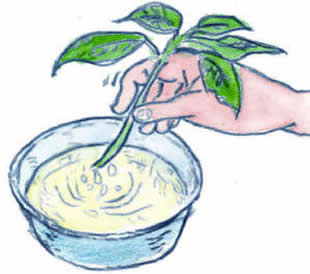
First treat the cuttings then plant them. Immerse the basal end of cuttings approximately one inch in the solution for a few seconds. Plant the cuttings immediately.
Use the lowest possible concentration to achieve the desired results. Excess concentration may result in reduced numbers of roots formed, phyto toxicity, shock, excessive callus, and rooting inequality.
Rates: using Hortus IBA Water Soluble Salts by plant variety see the Rates (Basal Quick Dip) by Plant Variety and Type
|
BASAL LONG SOAK METHOD
|
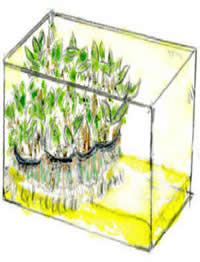
Use the Basal Long Soak Method on cuttings which are more difficult to root or are more woody. A long soak of the cuttings in a low concentration solution causes the plant tissues to absorb the active ingredients. Use this method on plants which may be sensitive to high concentration used in the Quick Dip Method. Immerse the basal end of cuttings approximately one inch in the solution for 12-25 hours nominal. Plant the cuttings immediately or cuttings can be stored in cold storage.
Rates
Hortus IBA Water Soluble Salts: 1/4 to 1/2 gram per liter of water.
|
| |
Basal Methods using Rhizopon AA Dry Dip rooting powders: |
DRY DIP METHOD
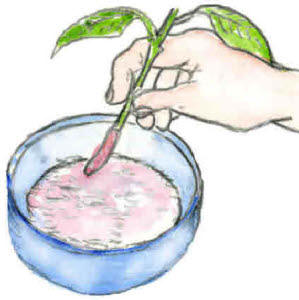 |
Dip the basal end of the cuttings 3/4 to 1 inch
into the Rhizopon AA dry powder
rooting hormones, one by one or in small bundles. Make sure that the
powder is evenly distributed in a thin even layer (1/32 to 1/16 inch)
over the whole base of the cutting. Too much powder on the cuttings
might result in excessive rooting where there is surplus powder. Root
formation can be expected all over the part of the cutting covered with
the powder. Avoid contact between the powder and foliage and other over
ground parts of the stem since it may cause phyto toxicity. Tap off the
excess powder. Plant the cuttings immediately in moist media. After
treating cuttings take care of them.
Rates for roses using Rhizopon AA dry powder
rooting hormones, usually
Rhizopon
AA #1 or Rhizopon AA #2 (best) early in the season
Rhizopon AA #3
(for harder to root cuttings) later in the season.
Rates: using Rhizopon AA dry dip rooting hormones by plant variety see the Rates (Dry Dip) by Plant Variety and Type
|
| |
Foliar Methods using solutions made with Hortus IBA Water Soluble Salts |
TOTAL IMMERSE METHOD
used at the same rates as the Spray Drip Down
|
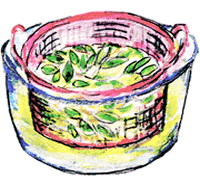
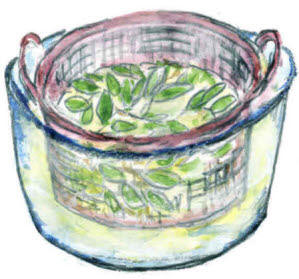
First totally immerse the cuttings in the fresh Hortus IBA Water Soluble Salts solution for a few seconds then plant them. You can use a basket to dip
the cuttings in a tub. Prevent bruising by not placing too many cuttings
in the solution at once. Allow time for the solution to dry on the
cuttings before watering, misting or covering. The temperature of the
solution should be at least equal to the cutting temperature. A cold
solution temperature causes the stomata of the cuttings close; the
amount of active ingredients absorbed is reduced.
.
Rates for roses if you use
Hortus IBA Water Soluble Salts: 3/4 to 1-1/4 gram per liter of water.
Rates: using Hortus IBA Water Soluble Salts by plant variety see the Rates (Spray Drip Down and Total Immerse) for Plant Variety and Type
There is a major benefit to use this method. The
bud eyes keep dormant until the root is developed thereby achieving a
stronger plant.
|
Spray Drip Down
used at the same rates as the Total Immerse Method
|
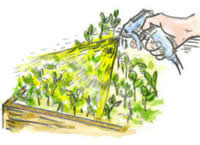
First plant the cuttings. Spray the
solution evenly over the cuttings until drops go down to the media.
Rates if you use
Hortus IBA Water Soluble Salts: 3/4 to 1-1/4 gram per liter of water.
Rates: using Hortus IBA Water Soluble Salts by plant variety see the Rates (Spray Drip Down and Total Immerse) for Plant Variety and Type |
Planting and Taking Care of the Cuttings: |
|
Hints
for taking care of the Cuttings |
Fill the pots firmly with a sterile potting mix
which is moist not soggy. Several cuttings can be planted in the same
pot. Treat the cuttings with rooting hormones using the Rhizopon AA dry
powder rooting hormone Dry Dip Method
or
Hortus IBA Water Soluble Salts (to make fresh solutions) Solution method.
Place the cutting in the
hole and firm the soil very tightly around it.
|
Control
the Humidity
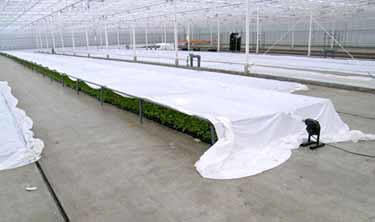 |
To prevent the cuttings from dehydrating through
the leaves and stems the cuttings are often propagated under mist
systems in controlled greenhouses or tunnels, in cutting trays covered
with plastic.
Maintain adequate moisture in the soil and air
humidity. Commercial growers usually use mist system to prevent wilting.
A fine mist of water is sprayed over the cuttings for a few seconds
every few minutes. Another method is to stick the cuttings in pots or
trays then cover and seal the pot with clear plastic; a poly bag works
well when covering a small pot. When available use a misting system.
|
"Pop-Bottle Method"
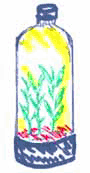 |
Construct "greenhouses" for the cuttings using
empty 1 or 2 liter soft drink bottles small pots or cups which are larger in the top then the bottom of the soda bottle.
For old style soda bottles: use a knife to
cut off the bottom of the bottle where the solid-colored section is
joined to the clear section. For new style bottles: cut off the bottom. Keep the bottle cap.
Use pots which fit into the bottle bottom.
The top of the bottle should
just fit snugly inside the pot rim. If you have the old style bottle bottoms, use them as a pot holder.
Place the top from the soda bottle
over the cutting and press it gently into the soil. Make sure that there
are no gaps through which evaporation could occur. Put the cap on the
bottle, but do not tighten.
After a few hours check the bottles to make
sure there is some moisture condensed on the inside of each. If not,
your soil may not have been moist enough and a small amount of
additional water should be added.
Place the bottles in a bright light
but not in direct sunlight as below. In the hot Summer keep in bright
shade to prevent over heating the tender plants.
|
"Baggie
Method"
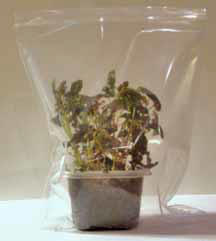 |
Use large zip lock clear plastic food storage
bags to create the greenhouse atmosphere. Fold the top of the bag down
several inches in order to keep the zipper clean while filling the bag.
Place some moist potting soil into the bag. Firm both soil and bag into
a ball shape with a flattened bottom. Use a stick to poke a 2" deep hole
in the soil not the plastic. Treat the cuttings with rooting hormones.
Insert the cutting. and firm the soil tightly around it. Unfold the top
of the bag and close most of the zipper, leaving the last inch open.
Inflate the bag to expand it then close the remaining length. Finally,
place the bag in indirect light as below.
|
Control
after Sticking and Treating |
Place the cutting pots in a place where heat
does not heat the cuttings. The cuttings should have bright light to
allow photosynthesis. In the spring many varieties will develop roots in
ten days to two weeks. Some varieties can be rooted in three to four
weeks. In the winter roots may form in four to eight weeks. To determine
if a cutting is rooted you can tug lightly on it; if it resists being
pulled out of the pot it is likely rooted.
Cuttings which are
treated by Hortus IBA Water
Soluble Salts by the Total Immerse Method will develop roots fast and
have a delayed bud sprout. The cutting is initially putting its energy
to making roots before making leaf.
Take care of the cuttings.
Acclimation of the newly-rooted plants should be done gradually. After
the cuttings are rooted remove discontinue the mist or remove the cover.
Harden them off for a few days by putting the pots in the shade in a
cool place. Once the plants have adjusted to normal humidity they can be
place in regular pots to continue their growth. After the plants have a
good root system move them into brighter light.
|
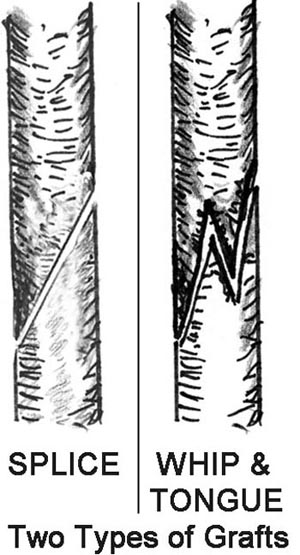
| Stenting:
Graft shown with scion top and rootstock bottom

|
Stenting is a method for the quick propagation
of roses. Cutting and grafting is performed in one action. In Dutch the
word "stenting" means "to stem". It is a combination "stekken" meaning
"to strike a cutting" and "enter" meaning "to graft". The success of
simultaneous cutting and grafting is cost effective.
In practice,
the scion consists of the cultivar stem taken with one leaf and a
dormant bud. The scion is grafted on a single internode of the
non-rooted rootstock. Formation of the graft union and of adventitious
roots on the rootstock occur simultaneously. The combined process takes
three weeks.
See Video:
Stenting of Roses in a Commercial
Greenhouse
|
Air Layering:
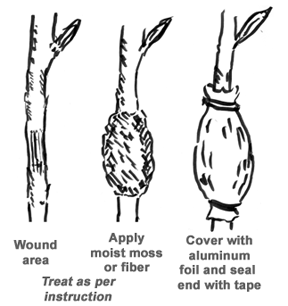 |
Air layering involves the wounding the stem of
the plant while it is on the stock plant. Treat the stem then cover it.
Roots form in the covered area. The tip of the stem sticking out of the
covered area will continue to grow. It will soon become a new plant with
it's own roots. The roots form at the wound. After the roots form sever
the stem from the stock plant.
Use Rhizopon AA dry powder rooting
hormones to treat air layers. Apply using a clean soft brush using
Rhizopon AA #2 or #3 dry powder rooting hormones. If using cocoa fibers
make sure the processing salts have been removed. As an alternate you
can use Hortus IBA Water Soluble
Salts @ Soak the moss or cocoa fibers in 150-500 ppm IBA.
Wound the stem of the cane. Apply the fiber. Cover the fibers with
aluminum foil to protect against drying out.
See: Other Special Techniques
|
| Improve Transplanting: |
Root regeneration of rose plants is promoted by
application of Rhizopon AA solutions. The active ingredients in applied to root segments increase the number of
regenerated roots as well as root length.
A rose crop often
starts with transplanting dormant material. Problems with survival and
bush development may be due to bad root re-growth (root regeneration). A
treatment that would decrease the time to new root initiation and
increase the number of roots or the elongation rate of the roots should
increase the chances of successful establishment and early productivity
of rose plants. Re-growth of roots is generally known as
root-regenerating potential (RRP) which is defined as the capacity of
roots to elongate or initiate and elongate new lateral roots.
Growers use Rhizopon AA when transplanting rooted rose bushes to improve
early flower yield. Roses, Inc. growers produce 80% of the rose flowers
grown in the US. These growers follow the lead of their Dutch
counterparts to increase flower yield by using Rhizopon AA. The
following is excerpted from a technical report published in the Roses
Inc. Bulletin (October 1992). |
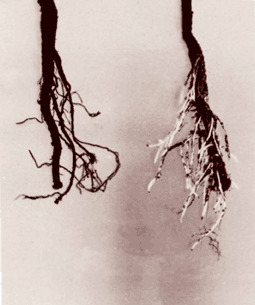 |
←The photograph on the left is an un-treated one
year rose bush. On the right is a
treated one year rose bush. Notice that the treated bush has more
fibrous growth and greater root mass.
Traditionally American rose
growers allowed one to two years of growth before transplanting rose
bushes. Without special treatment a young rose transplant uses its
energy to rebuild a root system instead of entire plant growth. Without
a strong root system the plant has reduced ability to feed and receive
water therefore subject to stress and possible mortality.
Dutch
growers, for over fifty years, transplant half year old rose bushes. To
improve root regeneration and increased first year flower yield when
transplanting bare root rose bushes the roots are immersed in a solution
containing Hortus IBA Water Soluble Salts. The
roots are not cut back except for damaged or broken roots. Living roots
contain stored carbohydrates. |
| Transplanting Technique: |
The bare roots of the rose bushes are immersed
for five minutes at Hortus IBA Water Soluble Salts at 50-100 ppm IBA. (The exact rate is not critical)
After treatment the rose
bushes are planted immediately. At planting time the soil temperature
should be above 60F and air temperature above 65F with relative humidity
at 80%. Warm soil temperature is a major factor in utilization of the
active ingredients. |
HORTUS IBA WATER SOLUBLE SALTS FACT SHEET
(download Fact Sheet)
 |
Hortus IBA Water Soluble Salts make fresh IBA, K-IBA rooting solutions for plant propagation from cuttings.This unique product is US EPA registered for use in greenhouses, nurseries, and technical programs.
• MAKING ROOTING SOLUTIONS: Hortus IBA Water Soluble Salts instantly mix and make rooting solutions using only WATER to dissolve; the solutions are free of alcohol and active solvents. No mix agitation is done. The powders stay in solution to over 100,000 ppm K-IBA (IBA), and powders NEVER drop out! High rates can be used to make stock solutions for decanting into production tanks. Solutions are close to pH neutral. No other products and tech. IBA and K-IBA can be made into such stable solutions.
• STORAGE: Dry Hortus IBA Water Soluble Salts in the original package have un-limited life. There is useful keeping life of solutions.
• SOLUTION METHODS: Use Hortus IBA Water Soluble Salts rooting solutions by all Basal & Foliar Solution Methods with ZERO HOUR REI and no required re-entry PPE. Hortus IBA Water Soluble Salts are used by any IBA or K-IBA solution method specified in technical literature or books and others. Ask your URC supplier, what Hortus IBA Water Soluble Salt rate they use in their own rooting stations. Methods: Total Immerse, Spray Drip Down®, Quick Dip, Basal Long Soak.
• DRY DIP METHOD: For rooting plant cuttings that effectively use dry dip rooting hormones, Rhizopon AA products are best. |