Use of plant rooting hormones with other growing agents
To save time, sometimes growers want to apply the rooting solution with a water based fungicide, or other growing agents, together. Selected rates for each product is used. Hortus USA does not recommend mixing Hortus IBA Water Soluble Salts solutions with other plant growth agents. There are many compatibility variables. The grower assumes all responsibility for mixing; evaluation trials must be made on small lots before any production lots are treated.
The method of application determines where the solution acts on the plant cuttings. Basal applications only are to the basal area; the cutting basal end is then stuck below the soil level. Foliar spray drip down application is done after the cuttings have been stuck in media; the solution only reaches the portion of the cutting above the media. Foliar total immerse application has the solution reach all parts of the cutting. Consideration should be made which parts of the cutting are intended to be treated.
Media
When propagating plants from cuttings consideration of individual plant needs relative to the media selected. Some requirements for media selection are pH, the need for water retention, and the absolute necessity of air oxygen to the cuttings. Pond or bog plant cuttings need a media that retains large amounts of water. Succulent plant cuttings need media that allows air flow while retaining little amounts of water.
Most terrestrial plant cuttings from woody plants, annual or perennials need different types of media. Media selection will allow needed oxygen to reach the cuttings. Cleanliness, sometimes sterilization, is essential to avoid pathogen introduction to the cuttings. Media combinations, with sand or pearlite, promote air getting to the cuttings..
Control the temperature
Temperature influences the speed to root cuttings. Higher temperature produces faster effect. If possible keep the temperature between 65-70F. High temperature accelerates fungus and bacterial growth above 70F. High temperature of the ambient air stimulates the growth of shoots at the expense of roots. Keep the air temperature lower than the soil temperature.
Control the light
After Rhizopon AA or Hortus IBA Water Soluble Salt treatment and planting in media the cuttings need light and water. For cuttings with leaves light is required for photo-synthesis to develop natural foods in the form of carbohydrates. Provide shade on bright, hot days to avoid scalding the cuttings. Cuttings without leaves do not require light for rooting; they depend upon stored carbohydrates.
Control the humidity
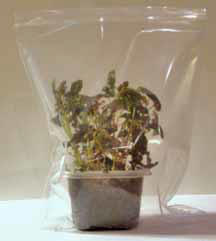 To prevent the cuttings from dehydrating through the leaves and stems the cuttings are often propagated under mist systems in controlled greenhouses or tunnels, in cutting trays covered with plastic. To prevent the cuttings from dehydrating through the leaves and stems the cuttings are often propagated under mist systems in controlled greenhouses or tunnels, in cutting trays covered with plastic.
Control hardening off
After root initiation harden off slowly by reducing the temperature and humidity. Frequently observe the growing environment and take action to assure that there are no fungus, insects, pathogens, etc. After the cuttings are rooted control the environment to bring the temperature and humidity to the ambient level.
Control the carbon dioxide
Maintain the carbon dioxide at about 1000 ppm.
Testing is essential
The condition of the cuttings or the rooted plant and the resultant rooting potency varies from season to season. Check the results regularly. Adjust the dosage, timing and method of application of Rhizopon AA or Hortus IBA Water Soluble Salt rooting products and other propagation materials. Fluctuation in the climate of the propagation area, varying light intensity, humidity, wetness of the media, type of media, frequency of watering, fungus growth, insect infestation, etc., will affect results. Carrying out a few tests will not take much time. The tests will keep you up to date with results. Tests go along with your normal growing operations and allow you to make timely corrective actions.
The Cuttings:
Cutting selection
Types of cuttings
Care of cuttings after treatment
|