Dr. James N. Cummins
N. Y. State Agricultural Experiment Station
Geneva, NY 14456
The following article is reprinted from the Pomona, Spring 1997, Volume 2, number34 XXX. Pomona is the publication of The North American Fruit Explorers (NAFEX, RR3 Box 167, Blomington IL 61704)
Success of a graft union depends on the establishment of a callus bridge between the cut surfaces of scion and stock, and the subsequent establishment of a functioning vascular cylinder connecting scion and stock. Initial callus formation appears to develop about equally on the cut surfaces of both partners, arising not from the cambial layers but from parenchyma cells, mostly in the wood just inside the camblum. Soon after scion and stock calluses have merged, callus cells just below the cambial cells of the scion begin to divide in the same plane as the camblum. Waves of cell division proceed from the top down, suggesting that a regulatory stimulus moves to the cut surface from the growing-shoot tip. Callus parenchyma cells inside the new camblum cylinder re-differentiate into functioning xylem cells. Last of all, the new cambium begins producing phloem cells.
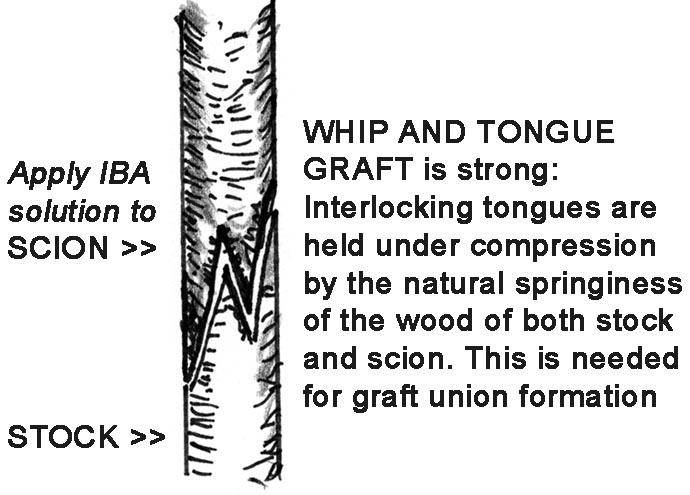
We sought to enhance that regulatory stimulus by applying a solution of a synthetic growth regulator. In the dormant season, we prepared whip-and tongue bench grafts of seven hardy varieties with potential as winter-tolerant frame builders. On half of the grafts of each variety, we applied a 2000 ppm solution of IBA (3-indole butyric acid) [ed note: useHORTUS IBA WATER SOLUBLE SALTS ROOTING SOLUTION @2000 PPM IBA] to the cut surface of the scion before joining stock and scion. After four weeks of callusing in a storage cellar at about 45 to 50F, we planted the grafts in the nursery; during the summer, we provided normal tillage but no irrigation. Trees were harvested in November. We evaluated each set for survival and for tree quality.
With all seven varieties, survival was greater for the IBA-treated grafts than for those not treated; with five of the varieties, all treated grafts survived.
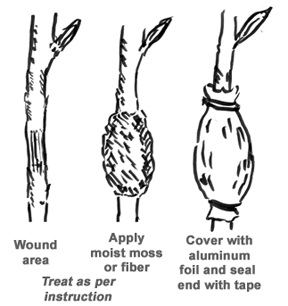
(The following drawing is added to the original article in order to clarify the method)