INTRODUCTION
In past years, reforestation practices have relied heavily on the use of natural seeding, direct seeding, and nursery-grown stock. Within the past few decades, genetic improvement of tree species has caught fire within the forest industry. Research involving hybridization between superior species, as well as creating orchards of improved trees, have been examined. One factor of concern is time. In order to realize genetic goals in tree species, several generations of tree breeding is required. Usually each generation requires anywhere from 15 years to 50 years depending on the species of topic (Ahuja and Muhs 1985). The dilemma is how to speed up this process. Asexual propagation has been one answer. The ability to harness superior genetic traits through asexual reproduction is being examined in many forest tree-improvement programs. Because of the shortened time requirement for cuttings of superior trees to root and grow, this method of reproduction is fast becoming a very important nursery management tool. Ritchie (1991) reported that in 1974 only three cutting propagation programs existed throughout the world. Since that time the amount of programs has increased dramatically with an increased realization of potential gains in growth and quality of trees. In order to maximize the potential genetic gain in propagation, ways to make this procedure cheaper must be discovered. Ernst J. Schreiner realized this in 1937 when he stated, "It is essential to find cheaper methods of vegetative propagation if select hybrids or strains are to be multiplied and utilized immediately for forest planting." (USDA 1937).
ADVANTAGES OF CUTTINGS OVER SEEDLINGS
The question of 'why?' is always an issue when change is discussed. With the topic of cutting propagation, this is no different. Why should a landowner or timber company use propagated cuttings instead of nursery raised seedlings? The answer is mainly quality. The yield of a tree produced from a cutting can be greater than a tree produced from a seedling. Characteristics of boles produced by cuttings are less tapered and potentially higher quality. Spencer (1987), examined the economic value of cuttings versus seedlings of radiata pine. It was discovered that because of the traits cuttings displayed, they were more valuable in timber production. The volume recovered was higher in trees produced from cuttings than from trees produced from seedlings. The taper in the bole of the seedling produced tree was greater than that of the cutting. The cuttings also produced 43% more volume of veneer than that of the seedling tree. The quality characteristics displayed by the trees grown from cuttings is, in part, attributed to the selection of trees, but mostly to the age of the parent stock from which the cutting was taken.
TYPES OF CUTTINGS
Cuttings, or 'ramet', are taken from a portion of the parent stock, referred to as the 'ortet'. Several types of cuttings can be taken from the parent stock, which depends on the point on the parent stock the cutting is taken from. The four major categories of cuttings are: 1) stem cuttings, 2) leaf cuttings, 3) leaf-bud cuttings, and 4) root cuttings. Brief descriptions of the four cutting types are discussed in below.
CUTTING TYPE
Stem cuttings
These cuttings are severed twigs that have been placed into growing medium and encouraged to develop roots. Speaking in general terms, the success of rooting of stem cuttings can be achieved by following a standard guideline. The following table from (Wright 1976), is a general guideline for propagation of stem cuttings. The type of tree species used will dictate variations in these methods:
Detach twigs during either winter or summer months, depending on what type of stem cutting is being used. Cuttings should be from current seasons growth.
Dip the cutting into a rooting hormone mix
Put the cutting in a rooting media (bury about 2/3 their height - if short length) (depends upon cutting length)
It is good to maintain a soil temperature of about 80 to 85 degrees F
Keep the above ground portion of the cutting moist and cool.
Stem cuttings are broken down into sub-classes consisting of hardwood, semi-hardwood, softwood, and herbaceous cuttings (Hartmann, 1975).
DRY DIP METHOD
Hardwood cuttings
Hardwood cuttings are taken from the current seasons growth. This portion of the tree offers young tissue. Cuttings should be taken during the winter months of November through February. Two main options are available when considering hardwood cutting techniques. Some species root easily and are capable of standing inclement weather sometimes experienced in the spring months. For these species, propagating without heat is acceptable. Other species that are sensitive to temperature should be propagated with the aid of heat.
Site selection is important when propagating hardwood cuttings without heat. This method often displays greater success in regions exhibiting mild winters. Protection from winds is also important. New tissue may become wind burned, or even killed. Windrows such as fences or native trees planted in rows will help reduce the risk of wind damage. Soils should have adequate drainage to ensure proper aeration. After cuttings are taken from stock hedges, they are prepared for planting. Cuttings should be between 200 and 250 mm in length. The cuttings are detached just below the node at the bottom and just above the node at the top. The cuttings are then stored in healing areas until soil conditions improve. As soon as the ground is capable of being planting, you should proceed. Once the cuttings have started producing top growth, they are easy to damage. Once in the ground, weed control, and irrigation should be administered. The following fall, cuttings are lifted.
Semi-hardwood cuttings
Cuttings of this type are produced from woody, broadleaf evergreens, and leafy summer cuttings. They are taken from partially matured portion of the plant, usually taken during the summer growing months just after new shoot development, and partially matured (Hartmann 1975).
Softwood cuttings
Softwood cuttings are taken from new, soft, succulent spring growth from either deciduous or evergreen species. Although softwood cuttings usually root easier and quicker than other cuttings, they also require more labor and equipment. This is because the cuttings are made with their leaves still attached. Therefore, they must be handled more carefully than hardwood cuttings. This type of cuttings generally utilize the aid of rooting hormones faster that other stem cuttings (Hartmann 1975). When choosing material for this type of cutting, care must be taken. The fast growing, soft, tender shoots are not desirable, because they have a greater chance of deteriorating before rooting occurs. The best material has some degree of flexibility, but will break if bent sharply (Hartmann et al. 1990).
Herbaceous cuttings
Herbaceous cutting are taken from succulent, herbaceous plants. This type of cutting roots fast, but is not used in forestry practice.
SPECIAL TECHNIQUES
Leaf cuttings
Though not used extensively in forestry applications, this cutting method warrants a brief mentioning. This form of propagation utilizes the leaf to promote new plant growth. A root and shoot will form and develop, from the leaf cutting, into a new plant. The original leaf cutting does not remain as part of the new formed plant.
Leaf-bud cuttings
This type of cutting propagation also is not used extensively in forestry applications, but a brief description is warranted. The leaf-bud cutting includes the leaf itself, petiole, and a small piece of stem with the axially bud. This form of cutting propagation is useful when material is scare, because the same amount of stock will produce twice as many new plants as that of stem cuttings (Hartmann et al. 1990).
IBA METHODS
Root cuttings
Root cuttings, which are used in forestry propagation, should be taken from the young plant stock during the winter and spring months to ensure that they are saturated with stored foods. This time frame also prevents cutting during the time the parent plant is rapidly expanding shoot growth. Cutting during active expansion will take food stores away from the root system (Hartmann et al. 1990). Another consideration when dealing with root cuttings is to make sure the polarity of the root is correct before planting. The portion of the root that was located nearest the crown of the plant should be planted up. A uniform system of identification of the top and bottom of the root is a good idea to insure correct directional planting.
TYPES OF PROPAGATION
Often several methods of propagating cuttings will be used in combination to optimize growth of the fastest and healthiest cutting. Below, are some common forms of propagation used for production of various species.
TAKING CUTTINGS
Hydroponics
Although not widely used on large scale forestry application, the use of hydroponics circulators is sometimes utilized for small scale research, as well as larger scale agricultural production. The hydroponics system cycles oxygen into the water where the cuttings are submerged. Nutrients are introduced into the solution to ensure no deficiencies occur. Although there is no immediate commercial use in the forest industry for large scale hydroponics systems, potential exists for its large scale utilization.
Mist
The use of mist in the propagation of plants was developed in the 1950's and has since revolutionized plant propagation. Because mist propagation is such an efficient and economical system to produce large quantities of rooted cuttings, it is one of the most widely used means of propagating cuttings in nurseries. This method has aided in the rooting of difficult species and also helps to decrease the rooting time of more "friendly" propagated species (Hartmann et al 1990).
Mist units usually are programmed to run continually or intermittently to ensure cuttings do not dry and wilt. Tests have shown that intermittent or interrupted misting is superior to continually misted cuttings. Hess and Snyder (1954), found that cuttings subjected to interrupted misting rooted faster and developed a better root system than cuttings subjected to continuous misting. This increase in performance gained by using the interrupted mist is due to the physical condition of the growing medium. The reason mist propagation works so well is that it simulates the real growing environment of the plant. The optimal growing conditions of plants is a cool moist leaf area, and a warmer soil area. Interrupted mist uses less water, which keeps the medium warmer and closer to the optimum conditions required for good rooting. Constant mist lowers the temperature of the medium below this optimum point because of the large amounts of water used.
The main advantage of misting is that this system keep leaves cool, and moist. This maintains turgor pressure and prevents them from wilting. Because of the lack of roots, cuttings must be keep moist to ensure survival. Priapi, (1993) formulated four criteria to determine if a plant species can be propagated using mist.
Those criteria are:
Plants that are not adversely affected by excessive misting
Plants requiring normal patterns of misting
Plants needing to be kept fairly dry
Plants requiring special attention in methods of overwintering.
Misting can be done in outdoor areas, or in closed greenhouses. In outdoor misting two key factors contribute to the success of a program. A well designed and drained bed, and plant species that are capable of being propagated using the misting method. In outdoor misting, windbreaks should be used to ensure uniform moisture coverage over all cuttings.
Indoor misting programs can be used in combination with other propagation techniques to further decrease the amount of time required for rooting and the quality of rooted cuttings produced. Bottom heating of the beds, which is discussed later, can help cuttings root faster. This system, in combination with misting, is especially useful during winter months. It is critical to maintain adequate ventilation with indoor misting. Without ventilation, excessive heat can build-up causing damage to the cuttings. Table 1 shows the rooting times of general categories of plant types using misting.
Table 1: Time required for mist-propagation to produce rooting
| |
Type of cutting |
Rooting period |
| A |
Evergreens, difficult rooting (semi-ripe) |
Approximately 8 weeks |
| B |
Conifers, easy rooting (semi-ripe) |
Approximately 8 weeks |
| C |
Softwoods, forced stock plants |
Approximately 4 weeks |
| D |
Softwoods, normal method |
Approximately 4 weeks |
| E |
Conifers, dwarf, if not grafted (semi ripe) |
Approximately 8 weeks |
| F |
Evergreens, easy rooting (semi-ripe) |
Approximately 8 weeks |
| G |
Conifers, difficult rooting (semi-ripe) |
Approximately 8 weeks |
(Stanley and Toogood, 1981)
CUTTING CARE
Fog
Fog units are another form of supplying water to cuttings. Fog units produce very fine water vapors (<20m). One difference between foggers and mist units is the fog stays in the air long enough for evaporation to occur. Evaporation causes the relative humidity to rise to between 93 and 100 percent. Moisture from mist units lose suspension and fall to the leaf surface and medium below. When the mist drops to the surface, it can leach nutrients out of the medium, in addition to, over-wetting the medium. One disadvantage to fog units is the cost related to them. Mist units usually cost less (Hartmann et al. 1990).
Greenhouses
The term 'greenhouse' is a fairly generic term. This structure is basically a protection from the outside environmental conditions such as wind and temperature. The house is a framed unit covered with material capable of utilizing solar heat. Materials used to cover these houses are glass, plastic, polyethylene, polyvinyl fluoride, fiberglass, and many other materials. One key aspect to remember when dealing with greenhouses is ventilation is absolutely essential for survival. Excessive heat build-up, which can happen fast, will kill cuttings (Hartmann et al. 1990). Greenhouse units are often used in conjunction with one or many other propagation techniques such as mist.
FACTORS AFFECTING CUTTING PROPAGATION
Propagation Media
No propagation method is going to work if the right media for growth is not used. In propagation, the air content of your media should be between 20 and 45 volume percent to promote root formation and growth. The volume percent in media should not drop below 15 volumes percent (Gislerod, 1983). This ensures adequate oxygen availability for the developing root systems. Increases in air within the media increases the oxygen diffusion rate (ODR). This increase is what will aid the root systems in acquiring the optimum amount of oxygen needed. The contents of media can vary for different regions and different species. Most mediums contain combinations of sand, peat, sphagnum moss, vermiculite, pearlite, compost, and shredded bark/sawdust (Hartmann 1975). The following is a guideline to follow to help obtain good results from your media:
The media should be firm and dense enough to hold the cutting without movement during rooting. Excessive shrinkage, of media, after drying is not desirable.
The media should be able to hold moisture so that excessive watering is not needed.
Adequate existence of pores for the purpose of draining of excess water. This will permit sufficient aeration.
The media should not contain weeds, unwanted seeds, nematodes, and other noxious organisms.
Salinity levels should not be excessively high.
Media should be capable of being sterilized with steam.
The availability of nutrients for plant growth should be adequate
(Richards, et al., 1964)
HORMONE TREATMENTS
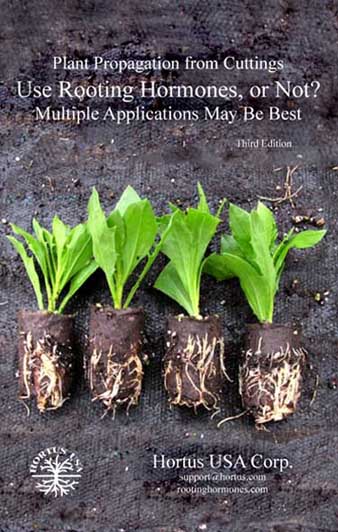
Indole butyric acid (IBA) and naphthalene acetic acid (NAA) are two synthetic rooting chemicals that have been found to be reliable in the promotion of rooting in cuttings. IBA is widely applied in general use because it is non-toxic to most plants over a wide range and promotes root growth in a large number of plant species. Both of these chemicals are available in talc or in liquid formulations.
ROOTING PRODUCTS
TRICKS
EFFECTS OF CUTTING SIZE ON SUCCESSFUL PROPAGATION
Very thin cuttings do not have the food reserves thicker cuttings have. This may lead to mortality before the cutting has a chance to root. The length of the cutting may vary depending on the species. Cutting sizes range from 2 inches to over 16 inches (Frampton and Hodges 1989, Foster 1990, Edson et al. 1991). Smalley and Dirr (1988) discovered that a two inch long cutting of red maple grew straighter than the larger cuttings, and the rates of growth after out planting was similar.
PLANT LIST
SHADING
Shading of cuttings was once thought not to benefit the cuttings in their task of root development. It was believed that shading cuttings hindered the photosynthesis process, which would reduce the rooting activity. Photosensitize is responsible for the production of carbohydrates which will aid cuttings in the formation of roots. There are several reason associated with shading. It prevents leaf scorch, and aids in the prevention of excess buildup of carbohydrates, which will actually hinder the development of rooting systems (Stanley and Toogood 1981). An adequate amount of shading is around 20% from the beginning of spring to the end of fall.
WATER QUALITY AND AVAILABILITY
The issue of water potential is extremely important with any type of cutting propagation. Since the cuttings have no root system, they cannot maintain turgor pressure in the absence of water, even for short periods of time. This makes the availability of water critical to cuttings survival. When the cutting is taken from the parent plant, the turgor pressure is broken. This pressure is similar to a rubber band, in that as water stress becomes higher, the force exerted from the top of the plant to get water from the roots increases. As water availability increases this pressure is reduced. Under normal conditions a plant can adapt, or adjust to situations of lower water availability through what is termed osmotic adjustment, in order to keep from wilting and dying. Osmotic adjustment occurs when the osmotic potential, at turgor loss, of a plant is lowered through the active accumulation of solutes in the cells (Turner and Jones 1980, Fan et al 1994). Cuttings do not have this luxury because they have no root system. Instead of adjusting, the cutting will wilt and die without constant water. As the root system develops, the plant will be able to take up water from the soil more efficiently.
HEAT
Thermo-chemical reactions, which means the speed of plant activity is directly related to the temperature, it one of the most important aspects of successful propagation (Wells 1955). As temperature rises, the respiration of a plant will also raise. In common terms; higher temperatures, to some point, will generate higher activity levels in the plant.
This section will examine the propagation programs in several countries. Other countries obviously have tree improvement programs, but these few countries comprise a large part of the active programs.
PROPAGATION IN DIFFERENT COUNTRIES
JAPAN
Japan is the single largest producer of cuttings. Although propagation of sugi plants has dated back as far as 500 years ago, the planned application for genetic improvement of trees was anticipated after the end of World War II (Toda 1973). In 1985 the Japanese planted a total of about 31 million trees on both public and private lands, that were created from cuttings. The field performance of sugi cuttings is similar to sugi seedlings. The initial growth of the cuttings is slightly slower than the seedlings, but the cuttings displayed resistance to needle blight, which has been a problem with seedlings. The Japanese plan to continue programs steered toward the improved resistance to destructive agents (Ritchie 1991).
AUSTRALIA AND NEW ZEALAND
The only conifer propagated on a large scale in these two countries is radiata pine (Pinus radiata). Over ten million cuttings are produced by several industries for the purpose of increasing the limited supply of genetically altered seed. Controlled cross seeding is the main method of propagation. Both countries report 90-95% success of directly rooted juvenile cuttings (Ritchie 1991). Australians are moving in the direction of producing all trees from cuttings. They are preparing for this transition by developing controlled pollination orchards in conjunction with nurseries to grow the cuttings. In 1982, the Tasmania forest began producing radiata pine from rooted cuttings on a commercial basis (Arnold and Glued 1985). New Zealand's methods are being adopted by Tasmania forestry. They are also currently researching methods to arrest the maturation of plant stock (Retch 1991).
SCANDINAVIA
Norway spruce is a major cutting of Scandinavia, with about 8 million rooted cuttings produced each year. Within this region, Norway is the largest producer. Northern portions of Norway have had little success with seed orchards programs. Cuttings have been used to supplement the low supply of seeds. In the southern regions of Norway, seed orchards have met with greater success than their northern counterparts. In the south, cutting programs are used to harness the best quality trees, in an effort to reduce the rotation age of spruce (Ritchie 1991). Finland started experimenting with cuttings of Norway spruce in 1962, at the Foundation for Forest Tree Breeding. The hope of this project, and larger ones set up later, are to find ways to produce cuttings on a large scale for practical use (Lepisto 1973). Throughout the different regions of Scandinavia, various rooting programs exist; however, the future looks bright for the expansion of cutting propagation in this region. Research priorities include the quest to mechanize various steps in the process of propagation, and improved rooting (to decrease production costs)(Ritchie 1991)
NORTH AMERICA
The North American cutting programs, while smaller than previously discussed programs, encompasses a larger variety of species, goals, and production. Canada comprises the majority of cutting propagation in North America. The Canadians feel that, while a relatively small part of the total reproduction program, rooted cuttings are the most viable option to introduce improved trees into these programs. The black spruce seed source is preferred in different regions, but is in short supply. Cape Breton Island produces rooted cuttings to increase the supply of this species. Canada also produces smaller amounts of white spruce, Norway spruce, and hybrid larch. In the United States, two companies have begun propagation programs. The International Forest Seed Company and Weyerhaeuser Company both are attempting to enhance and improve existing seed sources of loblolly and Douglas-fir respectively. Cuttings in the North American region are obtained differently by each region (Ritchie 1991).
GREAT BRITAIN AND IRELAND
Sitka spruce and, to a smaller degree, a hybrid larch are produced in these two countries. With sitka spruce being the most important conifer species propagated, Great Britain's objective with their program is simply to increase this scarce seed, while the main objective of Ireland is for clonal testing. Cutting production is currently at 150,000 specimens. Although production is expected to reach about 10 million cuttings by the year 2000, recent governmental fiscal policy could reduce the demand for cuttings. Prior to March of 1988, full tax credit was allowed for the cost of reforestation, and forest management. After March 1988, a fixed amount is deferred from reforestation and management costs. This loss of aid has decreased planting and interest in costly planting stock. Because of this situation, research has focused on examining ways to decrease production costs. Also, interest is focused on producing hybrid larch and several other important species (Ritchie 1991).
WESTERN EUROPE
The western European community is currently incorporating large cutting programs in Germany, France, and Belgium. The main species of concentration are Norway spruce and maritime pine. In Germany, the cutting program attempts to reproduce clones that have undergone extensive selections. These cuttings are put in nursery environments and grown for several years to examine the affects of donor maturation on the vigor of cuttings. A second reason for German's propagation program is to protect a disappearing genetic resource. Due to pollution, many trees no longer produce seed. Propagation is a way to ensure the continued genetic traits of these trees. While Germany is interested in preservation and genetic gains, France is focused on the commercial production of maritime pine cuttings. A goal of 1 million rooted cuttings per year has been established. Although Belgian programs are considerable small that either Germany or France, production of rooted cuttings is expected to double in the near future. Future production of cuttings is expected to increase during the next several years in Belgium, as well as many countries in Europe (Ritchie 1991).
EASTERN EUROPE
Czechoslovakia is currently trying to propagate Norway spruce that display tolerance to air pollution for use in high altitude forests. Poland currently has programs examining:1) re-construction of damaged lands by air pollution and tree species to aid this task, and 2) production of fast growing species. Future propagation in Eastern Europe will be centered around growth and wood quality. Specific qualities strive for are resistance to air pollution, frost, and wind damage. Technological propagation techniques must be made and monetary resources must be available if this region of the world is to continue its genetically path (Ritchie 1991).
OTHER FORMS OF PROPAGATION
In the forest industry, propagation of cuttings is one of two major forms of genetic improved propagation. Grafting is the other form of propagation extensively used in forestry. In this form of propagation, seedling or cuttings are grown until the appropriate size is achieved. These seedlings or cuttings must be closely related to the species that will make up the top of the graft, or scion. The scion is attached to the under stock utilizing several possible methods and cared for until the two parts have grown together. Once this union has successfully been accomplished, the top of the under stock is removed and the graft is complete (Wells1955).
SPECIES RESPONSE TO PROPAGATION
HARDWOODS
Willows and cottonwoods are rooted from dormant season cuttings. Cutting programs with these two species is performed on a commercial scale. These species are considered extremely easy to root (Wright 1976).
Oaks, chestnuts, beeches, ashes, and walnuts are all considered extremely hard to root. When these species undergo vegetative propagation, grafting is usually the preferred method (Wright 1976).
CONIFERS
Monterey pine will usually root fairly easy is kept under shaded conditions. Cost for this species to be propagated is between 5 and 10 times greater that for producing seedlings (Wright 1976).
Radiata pines are often rooted directly in the nursery bed from cuttings taken from hedges and nursery stool beds. Rooted cuttings are bare root transplants. The performance of radiata cuttings seems to be closely related to the maturity of the stock plant. Cuttings from older stock (3 years +) has fewer branches, thinner bark, and generally exhibits traits of more physiologically mature trees. The cuttings taken from younger stock displayed slower growth characteristics of younger seedlings (Ritchie 1991). Radiata pine can be rooted using stem cuttings. Cuttings detailed from an experiment conducted by Arnold and Gleed (1985), state that cuttings were taken during the months of May through July. Cuttings were taken from younger parent stock (<5 years). In this experiment, cuttings were placed in outside beds and watered frequently. Rooting often took several months. Cuttings were significantly superior as branch size decreased. Cuttings showed less taper throughout the entire log than seedlings.
Norway spruce was first propagated by cuttings in 1830 by Oberforster Pfifferling in Hessen. Since this time genetic propagation programs have started to examine and develop various improvements to this species (Kleinschmit 1973). This species rooting response is greatly influenced by the medium and treatment. Rooting success is greater in young plants, and in some instances success decreases as age of parent stock increases. Fertilization increases the ease of rooting. Hormone treatments influences rooting differently at seasons, age of the cutting, and its position on the tree (Kleinschmit 1973).
FUTURE OUTLOOK
Although seedlings still cost less in most regions of the world, rooted cuttings and other forms of genetic enhancement through propagation could be the key to the future. Growth performance of cuttings is almost identical, if not better, than that of seedlings. In addition, with cuttings, often the end product is utilized more efficiently at the mill due to less taper and general growth characteristics of more mature trees. In addition, cuttings are capable of producing a higher percent of veneer, and higher quality lumber. Propagation also produces uniform, cream of the crop trees consecutively, where seedlings may vary, even within the same family. In the near future, a widespread commercial production of cuttings could be the replacement of current seedling production. Through research, a reduction in the cost of commercially sold seedling, and the ability to sale and grow higher quality trees is not far in the horizon.
WATER BASED IBA ROOTING SOLUTIONS
REFERENCES
Ahuja, M.R., and Muhs, H.J. 1985. In vitro techniques in clonal propagation of forest tree species. In: In vitro techniques, propagation and long term storage. Edited by A. Schafer-Menuhr Martinus Nughoff/Dr W. junk publishers. 1985. P. 41-49.
Arnold, R. and Gleed, J.A. 1985. Raising and managing radiata pine cuttings for production forests. Australian Forestry. 48 (3):199-206.
Edson, John L., Wenny, David L., Fins, Lauren. 1991. Propagation of western larch by stem cuttings. Western Journal of Applied Forestry 6(2): 115-125.
United States Department of Agriculture. Better plants and Animals. 1937.
Fan, S., Blake, T.J., and Blumwald, E. 1994. The relative contribution of elastic and osmotic adjustments to turgor maintenance of woody species. Physiologia Plantarum 90:408-413.
Foster, G.S. 1990. Genetic control of rooting ability of stem cuttings from loblolly pine. Canadian Journal of Forest Research 20(9): 1361-1368.
Frampton, L.J., Jr.; Hodges, J.F. 1989. Nursery rooting of cuttings from seedlings of slash and loblolly pine. Southern Journal of Applied Forestry 13(3):127-132.
Gislerod, Hans R. Physical conditions of propagation media and their influence on the rooting of cuttings: The effect of the greenhouse environment on the temperature of propagation media. Plant and soil 1983. (74):19-29.
Hartmann, Hudson T., Kester, Dale E., and Davies, Fred T. Jr. Plant Propagation: Principles and Practices 5th ed. 1990. Prentice-Hall, Inc. p. 647.
Hartmann, Hudson, T. Plant Propagation. 1975. Prentice-Hall, Inc. p.662.
Hess, Charles E., and Snyder, William E. Interrupted Mist Found Superior to Constant Mist in Tests with Cuttings. American Nurseryman Dec. 15, 1995. p. 11-12.
Kleinschmit, J. 1973. Use of vegetative propagation for plantation establishment and genetic improvement. New Zealand Journal of Forest Science. 4(2):359-366.
Lepisto, M. 1973. Successful propagation by cuttings of Picea abies in Finland. New Zealand Journal of Forest Science. 4(2):367-370.
Priapi, Victor M. Outdoor Mist Propagation. American Nurseryman. Dec 1,1993. p.30- 34.
Richards, S.J., Warbeje, J.E., Aljibury, F.K. Physical properties of soil mixes used by nurseries, California Agriculture.1964. 18(5):12-13.
Ritchie, Gary, A. 1991. The commercial use of conifer rooted cuttings in forestry: a world overview. New Forests. 5: 247-275.
Spencer, D.J. 1987. Increased yields of high quality veneer and sawn timber from cuttings of radiata pine. Australian Forestry. 50(2):112-117.
Stanley, John, and Toogood, Allan. 1981. The modern Nurseryman. Faber and Faber Limited. London. p. 412.
Toda, Ryookiti. 1973. Vegetative propagation in relation to Japanese forest tree improvement. New Zealand Journal of Forest Science. 4(2):410-417.
Turner, N.C., and Jones, M.M. 1980. Turgor maintenance by osmotic adjustment: A review and evaluation. Adaptation of plants to water and high temperature stress. Edited by N.C. Turner and P.J. Kramer. John Wiley and Sons, New York p. 87-103.
Wells, James, S. 1955. Plant Propagation Practices. The Macmillan Company, New York, NY. p. 344.
Wright, Jonathan W., 1976. Introduction to Forest Genetics. Academic Press. New York, NY. p. 463.
OTHER ARTICLES
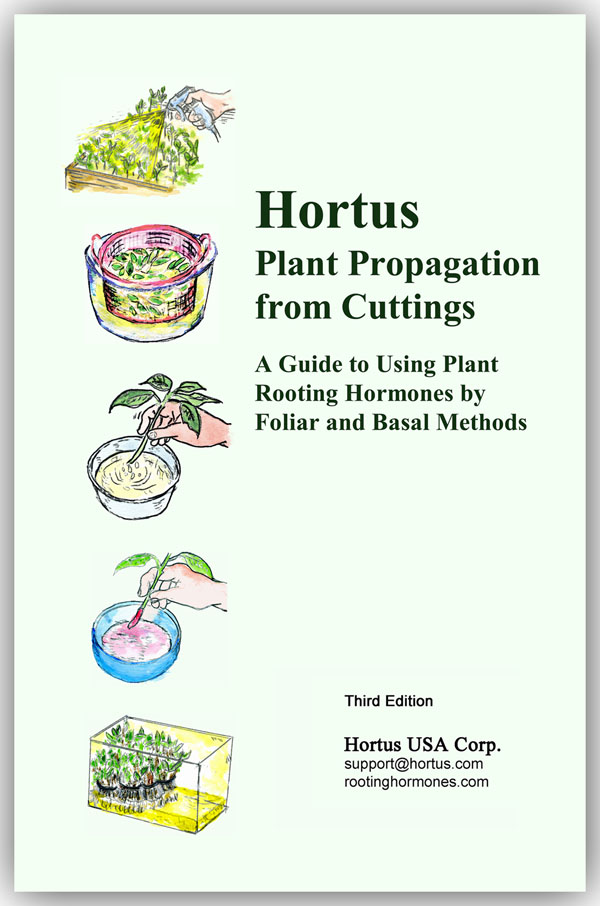
Five effective methods to propagate plants from cuttings:
Foliar: Spray Drip Down and Total Immerse Methods
Basal: Long Soak Method, Quick Dip Method, Dry Dip Method
|